
The Library
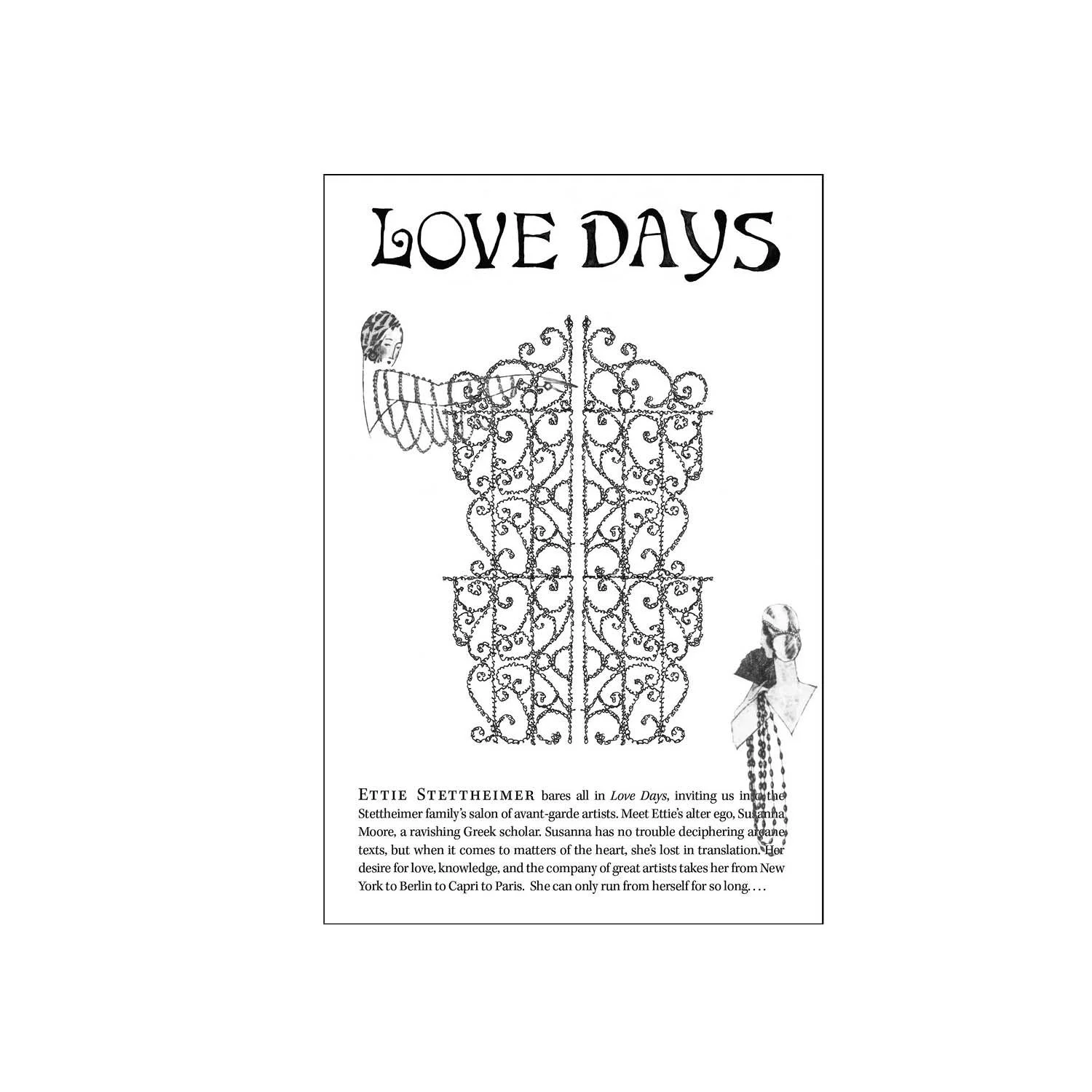
Ettie Stettheimer bares all in Love Days, inviting us into the Stettheimer family’s salon of avant-garde artists. Meet Ettie’s alter ego, Susanna Moore, a ravishing Greek scholar. Susanna has no trouble deciphering arcane texts, but when it comes to matters of the heart, she’s lost in translation. Her desire for love, knowledge, and the company of great artists takes her from New York to Berlin to Capri to Paris. She can only run from herself for so long. . . .
This is the book for you if…
You’re a world class flirt.
Your husband’s touch turns you to ice.
You’re not an artist, but a muse.
It’s all Greek to you.
Henrietta “Ettie” Stettheimer (1875-1955) was a writer and one of the “Stetties,” a trio of artistic sisters who lived between Europe and New York in the late nineteenth and early twentieth centuries. With Carrie, the architect of an elaborate dollhouse, and Florine, a painter whose iconoclastic canvases have made their way into the modernist canon, Ettie hosted a salon frequented by the day’s avant garde. In a time when it was still unusual for women to pursue higher education, Ettie graduated from Barnard College in 1896, received a master’s degree at Columbia in 1898, and earned her Ph.D. in philosophy at the University of Freiburg in 1908. Ettie published two novels, Philosophy: An Autobiographical Fragment and Love Days, under the pseudonym “Henrie Waste.”
Please note that we unfortunately cannot ship outside of the United States.
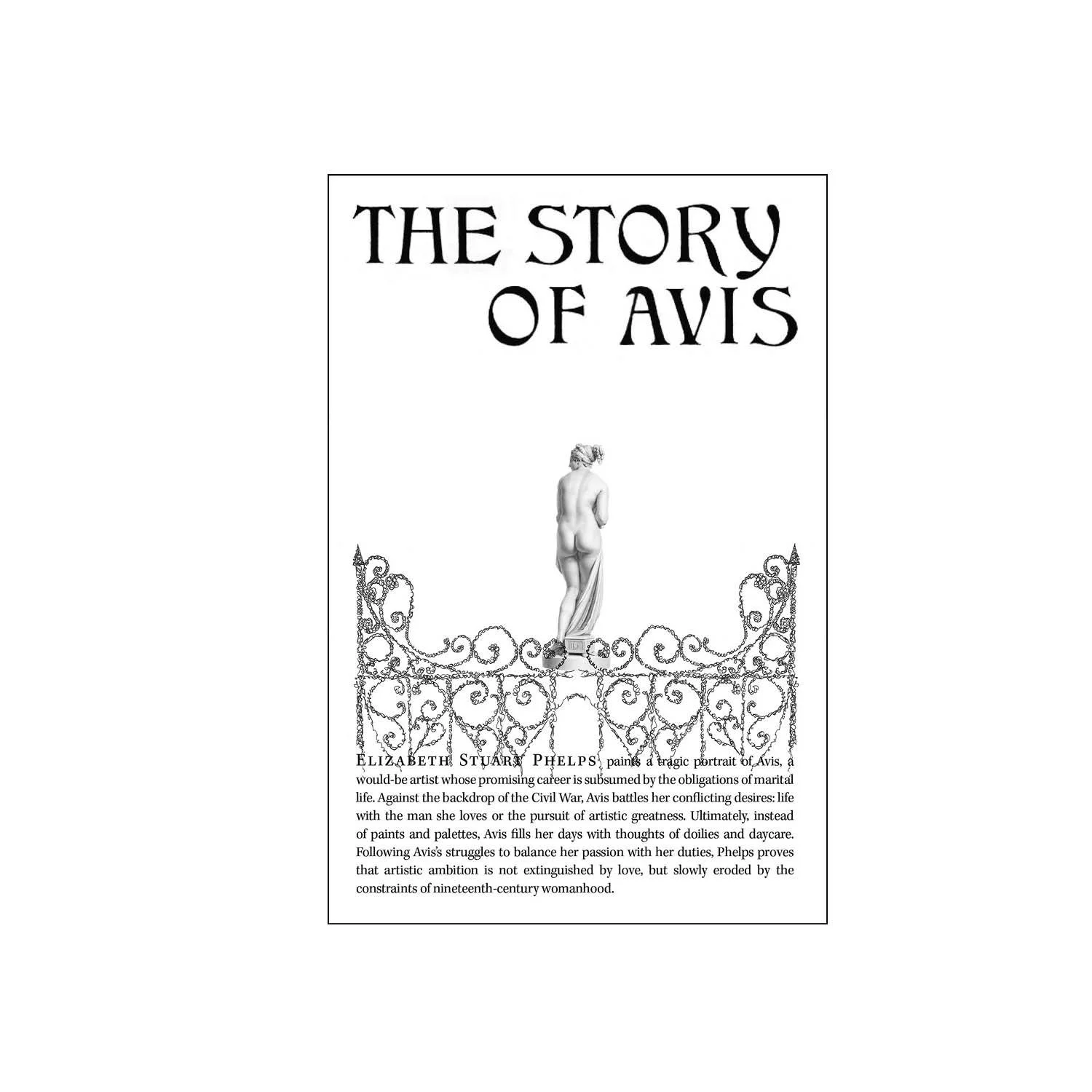
Elizabeth Stuart Phelps paints a tragic portrait of Avis, a would-be artist whose promising career is subsumed by the obligations of marital life. Against the backdrop of the Civil War, Avis battles her conflicting desires: life with the man she loves or the pursuit of artistic greatness. Ultimately, instead of paints and palettes, Avis fills her days with thoughts of doilies and daycare. Following Avis’s struggles to balance her passion with her duties, Phelps proves that artistic ambition is not extinguished by love, but slowly eroded by the constraints of nineteenth-century womanhood.
This is the book for you if…
You have the soul of an artist.
You are in an aura gap relationship.
Your daughter scares you.
You are as enigmatic as the sphinx.
Elizabeth Stuart Phelps Ward (1844-1911) was an incorrigible reformer, advocating at various points for dress reform, feminism, social reform, temperance, and an end to the practice of vivisection. In 1874, she penned a rousing call for women to burn their corsets, anticipating the bra-burning feminists of the following century. Her writing career began at 19, when she published a short story about the Civil War titled “A Sacrifice Consumed” in Harper’s Magazine. During her lifetime, she authored 57 volumes of fiction, poetry, and essays. She is perhaps best remembered for the trilogy of Spiritualist novels that she published in the wake of the Civil War—the first of which, The Gates Ajar, had sold 180,000 copies in the US and England by 1900.
Please note that we unfortunately cannot ship outside of the United States.
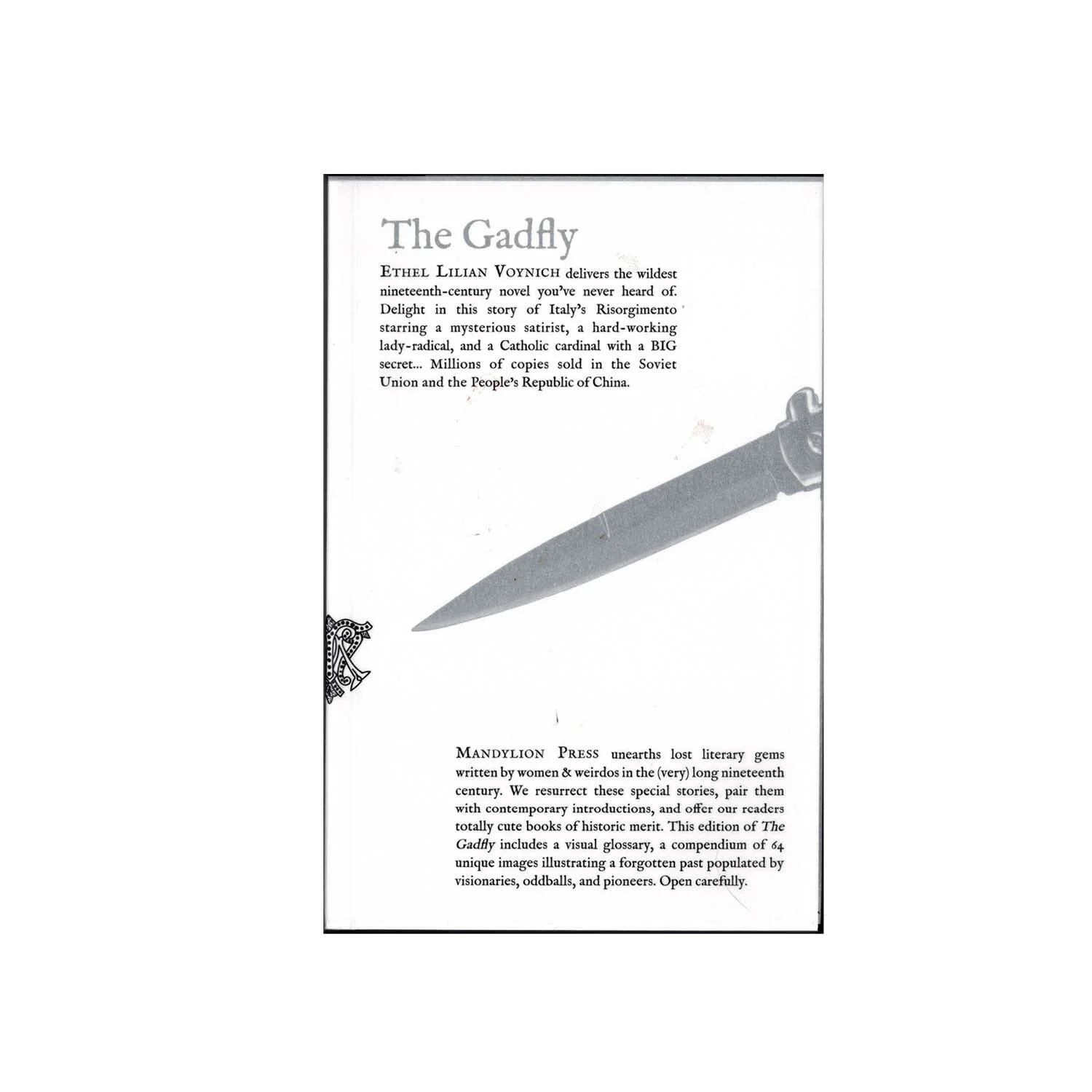
Ethel Lilian Voynich delivers the wildest nineteenth-century novel you’ve never heard of. Delight in this story of Italy’s Risorgimento starring a mysterious satirist, a hard-working lady-radical, and a Catholic cardinal with a BIG secret… Millions of copies sold in the Soviet Union and the People’s Republic of China.
This is the book for you if…
You’re a troublemaker.
You’re an unrepentant Catholic.
You have daddy issues.
You can’t take a joke.
Ethel Lilian (Boole) Voynich (1864–1960) was born in Cork, Ireland, and raised in Lancashire, England. Her peripatetic adult life was defined by passions for music and leftist politics. In 1902, she married Wilifrid Michael Voynich, a Polish revolutionary and antiquarian book dealer. She spent her final decades in New York City, where she worked in a music school and as a translator of Russian, Polish and French texts.
Please note that we unfortunately cannot ship outside of the United States.